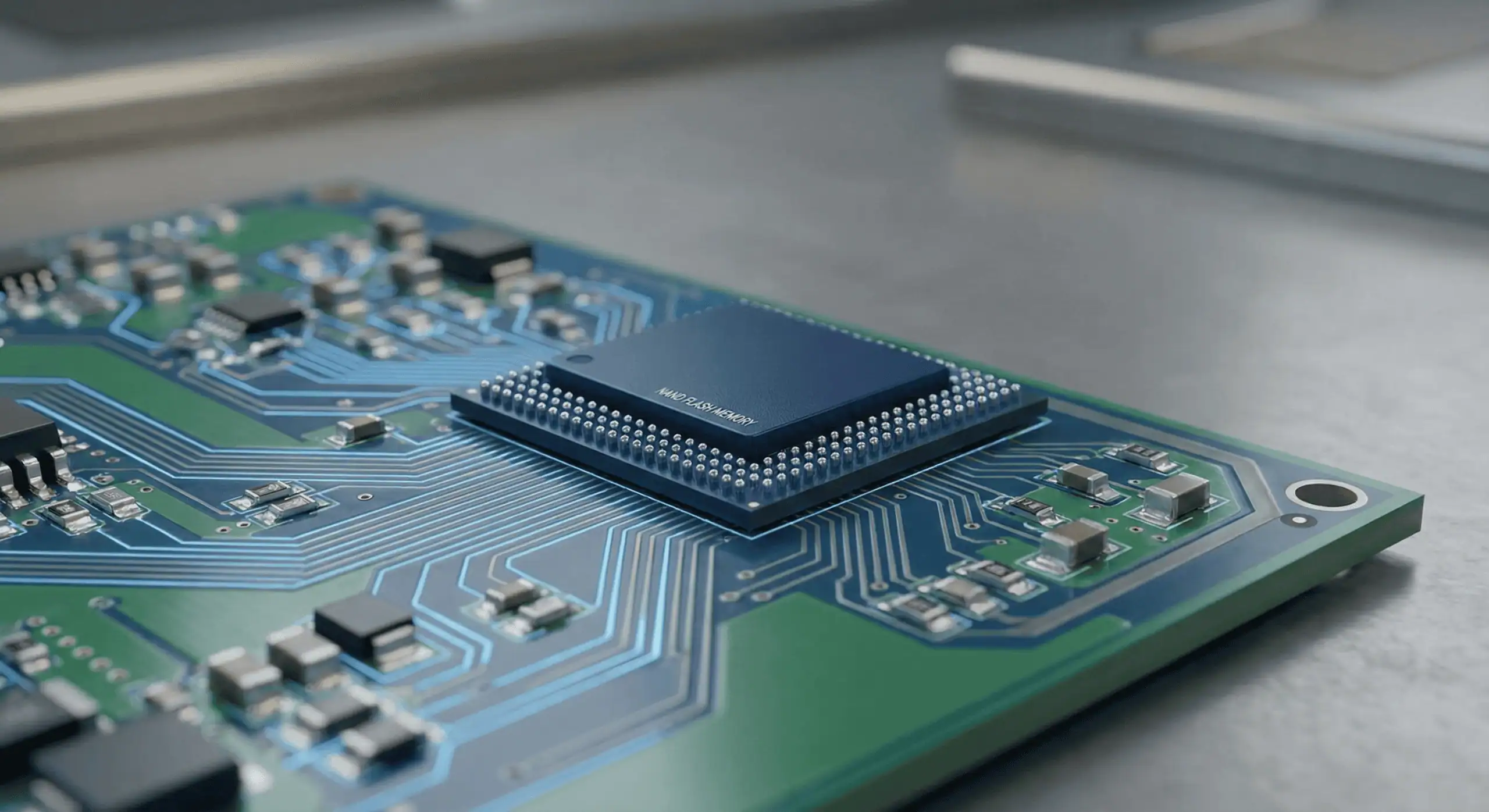
MT29GZ6A6BPIET-53IT: Why Industrial SLC NAND Still Matters in Embedded System Design
In an era dominated by headlines around high-density NAND, AI accelerators, and next-generation memory interfaces, it is easy to overlook the quieter components that continue to anchor real-world systems. NAND Flash is often discussed in terms of capacity and throughput, but in many embedded and industrial applications, reliability, predictability, and lifecycle stability matter far more than raw speed or storage size.
The MT29GZ6A6BPIET-53IT from Micron Technology is a strong example of this reality. It is an 8-Gbit SLC NAND Flash device designed for embedded systems where non-volatile storage must behave consistently over long deployment timelines. While it lacks the headline-grabbing densities of newer NAND generations, its continued relevance speaks to the different priorities that govern industrial and infrastructure-focused designs.

Wait… We Actually Have These In Stock!
You’re reading the details, now look at the stock. NetSource has in stock inventory for the part featured in this article.
Understanding the Role of the MT29GZ6A6BPIET-53IT
At its core, the MT29GZ6A6BPIET-53IT is a single-level cell (SLC) NAND Flash memory device compliant with the ONFI standard. With an industrial temperature rating and a compact WFBGA package, it is designed to integrate cleanly into embedded platforms built around microcontrollers, application processors, and SoCs.
Unlike multi-level cell NAND, SLC stores one bit per cell. That architectural choice significantly improves endurance, reduces bit error rates, and delivers more deterministic read and write behavior. For systems that rely on NAND Flash to store bootloaders, firmware images, configuration data, or critical logs, those characteristics are often more valuable than higher capacity per dollar.
This device is not intended to replace large storage subsystems. Instead, it fills a specific and enduring role: dependable non-volatile memory that system designers can trust across power cycles, temperature extremes, and long operational lifetimes.
Why SLC NAND Continues to Be Specified
From a design perspective, SLC NAND remains attractive precisely because it avoids complexity. Error management is simpler, write amplification is lower, and wear leveling requirements are easier to manage compared to TLC or QLC alternatives. That simplicity translates into lower software overhead and fewer long-term reliability surprises.
In embedded systems, storage failure is rarely a graceful event. If firmware cannot be read reliably or configuration data becomes corrupted, the entire system can fail to boot or operate incorrectly. For this reason, many engineering teams continue to specify SLC NAND for foundational storage tasks, even as higher-density NAND technologies dominate consumer devices.
The MT29GZ6A6BPIET-53IT fits squarely into this category. It is designed to be boring in the best possible way—predictable, well-characterized, and stable over time.

“In embedded platforms, storage is not about capacity. It is about trust.”
Where This Class of NAND Is Commonly Used
Devices like the MT29GZ6A6BPIET-53IT are widely deployed across industries where long validation cycles and extended field lifetimes are the norm.
In industrial automation, SLC NAND is frequently used in PLCs, motor controllers, and human–machine interfaces to store firmware and system configuration data. These systems are expected to operate continuously for years, often in electrically noisy or thermally challenging environments.
In telecommunications and networking equipment, reliable non-volatile storage is essential for boot code, routing tables, and persistent configuration. Infrastructure hardware is rarely refreshed on consumer timelines, making storage longevity a key consideration.
Medical devices represent another important segment. Regulatory validation, long service lives, and strict reliability requirements often push designers toward conservative memory choices. SLC NAND remains a common option for control systems and embedded processing modules within regulated environments.
Similar patterns appear in automotive electronics, particularly in control units outside of infotainment, as well as in aerospace and defense platforms where predictable behavior and traceability matter more than density scaling.
Lifecycle Stability and Supply Considerations
Industrial NAND Flash tends to remain in production longer than consumer-focused memory, but that does not mean availability should be taken for granted. Memory manufacturers continually rebalance capacity toward newer technologies and higher-volume markets. As a result, even proven industrial parts can quietly become harder to source over time.
The MT29GZ6A6BPIET-53IT sits in a category where lifecycle planning matters. While it is not subject to the rapid churn seen in mobile memory, it is still influenced by broader NAND market dynamics. Production priorities, wafer allocation, and shifts toward newer process nodes can all affect long-term availability.
For procurement teams supporting deployed platforms, this reality changes how sourcing decisions are made. Lead times become less predictable, and last-minute purchases may introduce unnecessary risk. Understanding where a component sits in its lifecycle allows teams to plan proactively rather than reactively.
“Legacy does not mean obsolete, but it does mean supply deserves attention.”
A Practical Perspective on Embedded NAND Selection
The continued use of parts like the MT29GZ6A6BPIET-53IT highlights an important truth about embedded system design. Not every component needs to follow the latest technology curve. In many cases, stability, validation history, and predictable behavior deliver more value than incremental performance gains.
SLC NAND Flash remains a deliberate choice for engineers building systems that must operate reliably over long time horizons. For organizations supporting those systems, understanding the technical role and supply characteristics of these components enables quieter, more effective risk management.
The MT29GZ6A6BPIET-53IT is not a flashy component. It does not need to be. Its relevance lies in the fact that it continues to do exactly what embedded systems demand of it—store critical data reliably, year after year, without drawing attention to itself.