1SG10MHN3F74C2LG: Stratix 10 GX 10M FPGA Specs, Ordering Code and Sourcing
1SG10MHN3F74C2LG is the Stratix 10 GX 10M FPGA: 10,200K logic elements in a 4,938-pin package, geared toward ASIC prototyping. Specs, lifecycle and sourcing notes.
By Ryan Munoz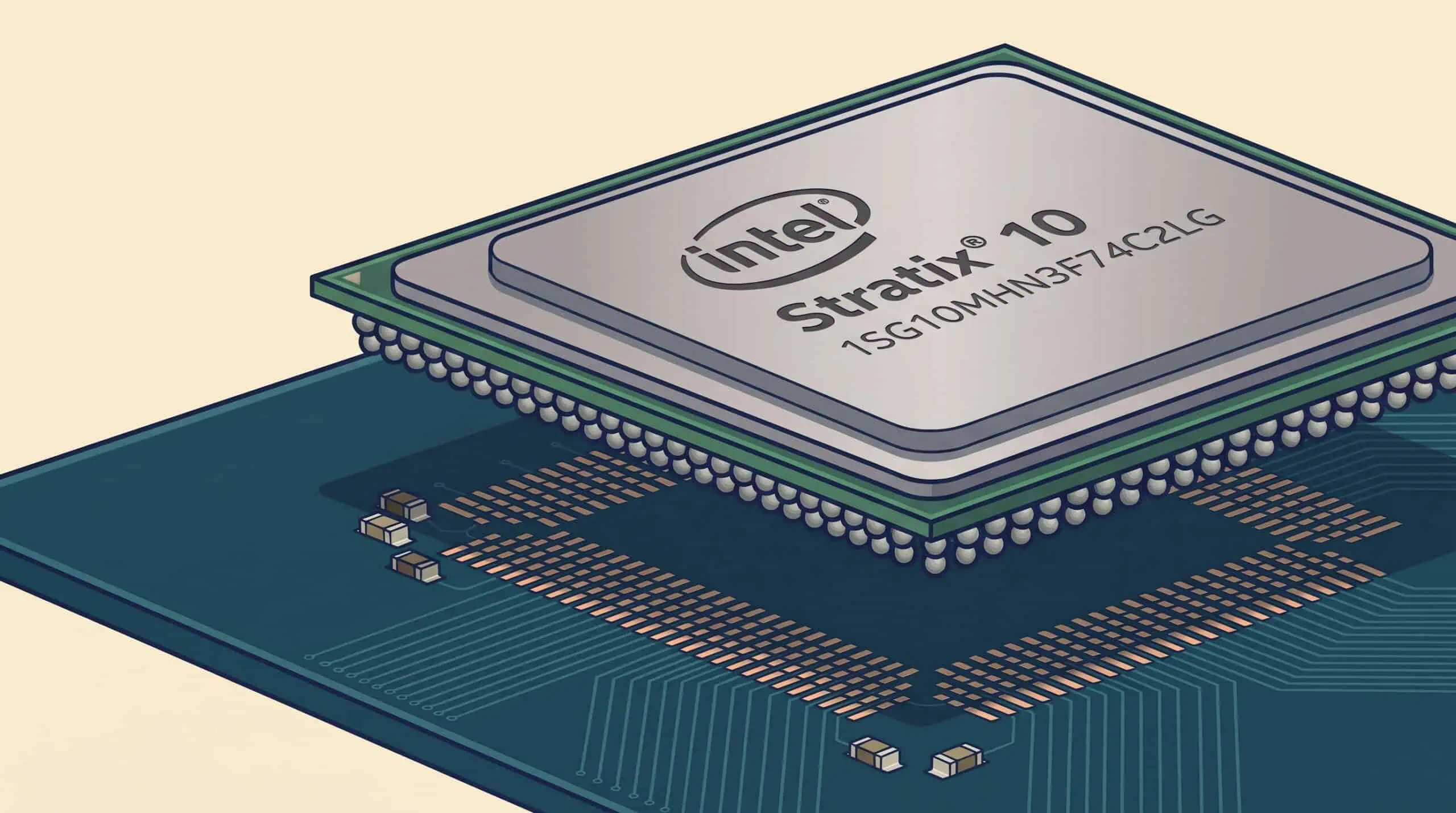
The 1SG10MHN3F74C2LG is a Stratix 10 GX 10M FPGA in the F74 FineLine BGA package, with 4,938 pins and 10,200K logic elements. It’s the largest device in the Stratix 10 GX line, and Intel positions it for ASIC prototyping and emulation hardware. Intel’s ordering page lists it as a current ordering code, and the Stratix 10 discontinuance notices issued so far name other devices.
Stratix 10 is an Altera product line. Intel bought Altera in 2015 and sold a 51% stake to Silver Lake in 2025, which made Altera an independent company again, with Intel keeping 49%. Current device documents carry the Altera name, though many parts listings still file the device under Intel.
What the 1SG10MHN3F74C2LG is
GX is the FPGA variant of Stratix 10. The SX variant is the SoC version. The device is built on Intel’s 14 nm tri-gate (FinFET) process with the Hyperflex core architecture. What sets the GX 10M apart is its construction. Altera’s device overview describes a dual core fabric with heterogeneous 3D system-in-package (SiP) transceiver tiles, and says this layout is used only in the GX 10M.
The ordering code decodes as follows, using the scheme in the device overview:
- 1S: Stratix 10 family
- G: GX variant, the FPGA (an X here would mean the SX SoC)
- 10M: logic density of 10,200K logic elements
- H: H-tile transceivers
- N: 48 transceivers
- 3: reads as transceiver speed grade 3 (the overview lists grades 1 to 3)
- F: FineLine BGA
- 74: package code, 4,938 pins, 70 x 74 mm
- C: commercial temperature grade
- 2: FPGA fabric speed grade 2 (1 is fastest)
- L: power option, low power with fixed voltage
- G: RoHS6, lead-free
The main specifications, from Altera’s device overview and product table unless noted:
| Specification | 1SG10MHN3F74C2LG |
|---|---|
| Logic | 10,200K logic elements |
| Embedded memory | 12,950 M20K blocks (253 Mb) plus 87,984 memory logic array blocks, or MLABs (55 Mb); Altera’s ordering data gives 308 Mb in total |
| DSP | 6,912 18×19 multipliers, with half that number available as 27×27 multipliers |
| Transceivers | 48 H-tile, in tiles of 12 full-duplex channels each |
| PCIe | 4 hard IP blocks, with PCIe 3.0 x8 support noted for the GX 10M |
| I/O | 2,304 general-purpose I/Os, 32 high-voltage I/Os and 1,152 LVDS pairs |
| LVDS rate | Up to 1.4 Gbps |
| Package | F74 FineLine BGA, 4,938 pins, 70 mm x 74 mm, 1.0 mm pitch |
| Process | 14 nm tri-gate (FinFET), Hyperflex core architecture |
| Temperature | Commercial grade, junction temperature 25 to 85 °C |
| Moisture sensitivity | MSL 3 |
Intel’s ordering page lists spec codes SREPW and SRR59 for this ordering code. It gives the Export Control Classification Number (ECCN) as 3A001.A.7.A and the Commodity Classification Automated Tracking System (CCATS) number as G171972.
Where the Stratix 10 GX 10M is used
Intel’s emulation and prototyping page says the Stratix 10 GX 10M is geared toward ASIC prototyping and emulation workloads. The page quotes 10.2 million logic elements, 2,304 user I/O pins, 308 Mb of memory and up to 48 transceivers at up to 17.4 Gbps. It spotlights two partner systems built on the device: an S2C prototyping system based on four GX 10M FPGAs, and PRO DESIGN’s proFPGA Quad system.
S2C’s product page for its Prodigy S10 10M Logic System offers the system with one or four Stratix 10 GX 10M FPGAs, and the quad version lists 40,800K logic elements. Both Intel and S2C describe the device as a whole and don’t tie these systems to a particular ordering code. Read them as context for the 1SG10M device family, not as a record of this exact part.
The reasons a prototyping team picks this device come down to capacity and visibility. With 10,200K logic elements, 253 Mb of M20K memory, 55 Mb of MLAB memory and 6,912 18×19 multipliers in one package, more of a large ASIC design can sit in a single FPGA. The overview also says GX 10M devices are the only Stratix 10 devices that support non-destructive register state readback and writeback, a feature it aims at ASIC prototyping. Capturing and restoring register state without disturbing it is useful when you’re chasing a bug in a design under emulation.
Selection and design notes
Start with capacity. If your design fits comfortably in a smaller Stratix 10 GX FPGA, the GX 10M’s package size and board cost are hard to justify. If it doesn’t, this is the ceiling of the GX line.
The 48 transceivers are H-tile, arranged in tiles of 12 full-duplex channels. Altera’s ordering data for 1SG10MHN3F74E2LG, which shares the H-tile, 48-channel and transceiver speed grade 3 fields with this part, gives a data rate of 17.4 Gbps. That matches the figure on Intel’s prototyping page for the device. Plan your high-speed links around that number.
For host connectivity, the device has 4 PCIe hard IP blocks, and Altera’s product table notes PCIe 3.0 x8 support for the GX 10M. Check that this fits your host interface before committing to a board architecture.
The I/O budget is large: 2,304 general-purpose I/Os, 32 high-voltage I/Os and 1,152 LVDS pairs, with LVDS running at up to 1.4 Gbps. In a multi-FPGA prototyping board, much of that I/O carries signals between partitions.
Altera’s data for the same device lists support for DDR, DDR2, DDR3 and DDR4 memory interfaces, Hybrid Memory Cube (HMC), MoSys, quad data rate (QDR II and QDR II+) SRAM, and reduced latency DRAM (RLDRAM II and RLDRAM 3).
The C grade covers a junction temperature of 25 to 85 °C. Size the heatsink and airflow for that window. The 70 mm x 74 mm body at 1.0 mm pitch with 4,938 pins also drives PCB layer count, breakout routing and assembly process, so involve your layout and assembly teams early. Fabric speed grade 2 sits one step below the fastest grade, and the L power option is the low-power, fixed-voltage version.
Replacement and migration considerations
Altera names no replacement, and none is needed while the part is active. Intel’s ordering page lists 1SG10MHN3F74C2LGNE next to this part, and Altera’s ordering data shows 1SG10MHN3F74E2LG as the same device in the same package. These are separate ordering codes, so treat them as distinct part numbers on your bill of materials and confirm the differences with the manufacturer before you substitute one for another.
The rest of the Stratix 10 GX family consists of smaller devices, from 378K to 2,753K logic elements, with a single (monolithic) core fabric and other packages. They are separate devices, so a move to one of them means a new footprint and a re-fit of your design. If you compare any candidate against this part, work through this list:
- Full ordering code, including every suffix
- Logic elements, M20K and MLAB memory, and DSP multiplier counts
- Transceiver count, tile type and speed grade
- PCIe hard IP blocks and supported link width
- General-purpose I/O, high-voltage I/O and LVDS pair counts
- Package, pin count, body size and pitch
- Temperature grade and junction range
- Fabric speed grade and power option
- Whether your debug flow depends on register readback and writeback, which only the GX 10M supports
Sourcing considerations
Franchised availability for this part is limited, and some franchised listings carry regional sales restrictions. When you buy from the independent market, ask for evidence on each of these points:
- The full part number on the paperwork and the device, matched character for character to 1SG10MHN3F74C2LG, including the final L and G
- Package marking checked against manufacturer conventions and compared across the lot
- Date codes and a traceability chain back to the original source
- Inspection and test records for the lot, with third-party lab testing where the risk warrants it
- Moisture handling: the device is rated MSL 3 (moisture sensitivity level 3, 168 hours at 30 °C / 60% RH or less), so check dry-pack condition and humidity indicator cards, and bake before reflow if exposure time is exceeded
- Country of origin documentation
Frequently asked questions
What is 1SG10MHN3F74C2LG?
It’s an Intel Stratix 10 GX 10M FPGA with 10,200K logic elements, 48 H-tile transceivers and 2,304 general-purpose I/Os, in a 4,938-pin F74 FineLine BGA package measuring 70 mm x 74 mm. The C in the code marks the commercial temperature grade.
Is 1SG10MHN3F74C2LG end of life?
Not according to any published notice. Intel’s ordering page lists it as an ordering code, and the Stratix 10 discontinuance notices Altera has issued (PDN2412 for selected MX, NX and DX devices, and PDN2029 for Engineering Samples) don’t name any GX 10M part.
What makes the GX 10M different from other Stratix 10 GX FPGA devices?
It’s the largest GX device and the only one with a dual core fabric and heterogeneous 3D SiP transceiver tiles. The device overview also says GX 10M devices are the only Stratix 10 devices with non-destructive register state readback and writeback.
How fast are the Stratix 10 GX 10M transceivers?
Altera’s ordering data gives 17.4 Gbps for a GX 10M ordering code with the same H-tile, 48-channel and speed grade 3 fields, and Intel’s prototyping page quotes up to 17.4 Gbps for the device.
Is the Stratix 10 GX 10M an ASIC prototyping FPGA?
Intel says the device is geared toward ASIC prototyping and emulation workloads. Intel’s page spotlights an S2C system based on four GX 10M FPGAs and PRO DESIGN’s proFPGA Quad system, and S2C offers its Prodigy S10 10M Logic System with one or four GX 10M devices. These sources describe the device, not a specific ordering code.
More FPGA and Intel parts at NetSource
Browse the parts we list, with date codes and RoHS status on each part page.

We source it
We source end-of-life and hard-to-find parts too. Send the part number and we'll quote it.
Request a quoteAny part number, in stock or not