
CY7C68013A-56PVXC: Cypress EZ-USB FX2LP Specs, End of Life and the FX2G3 Replacement
Cypress's CY7C68013A-56PVXC EZ-USB FX2LP is end of life: its specs, Infineon's discontinuation dates, where it's designed in and what the FX2G3 needs.
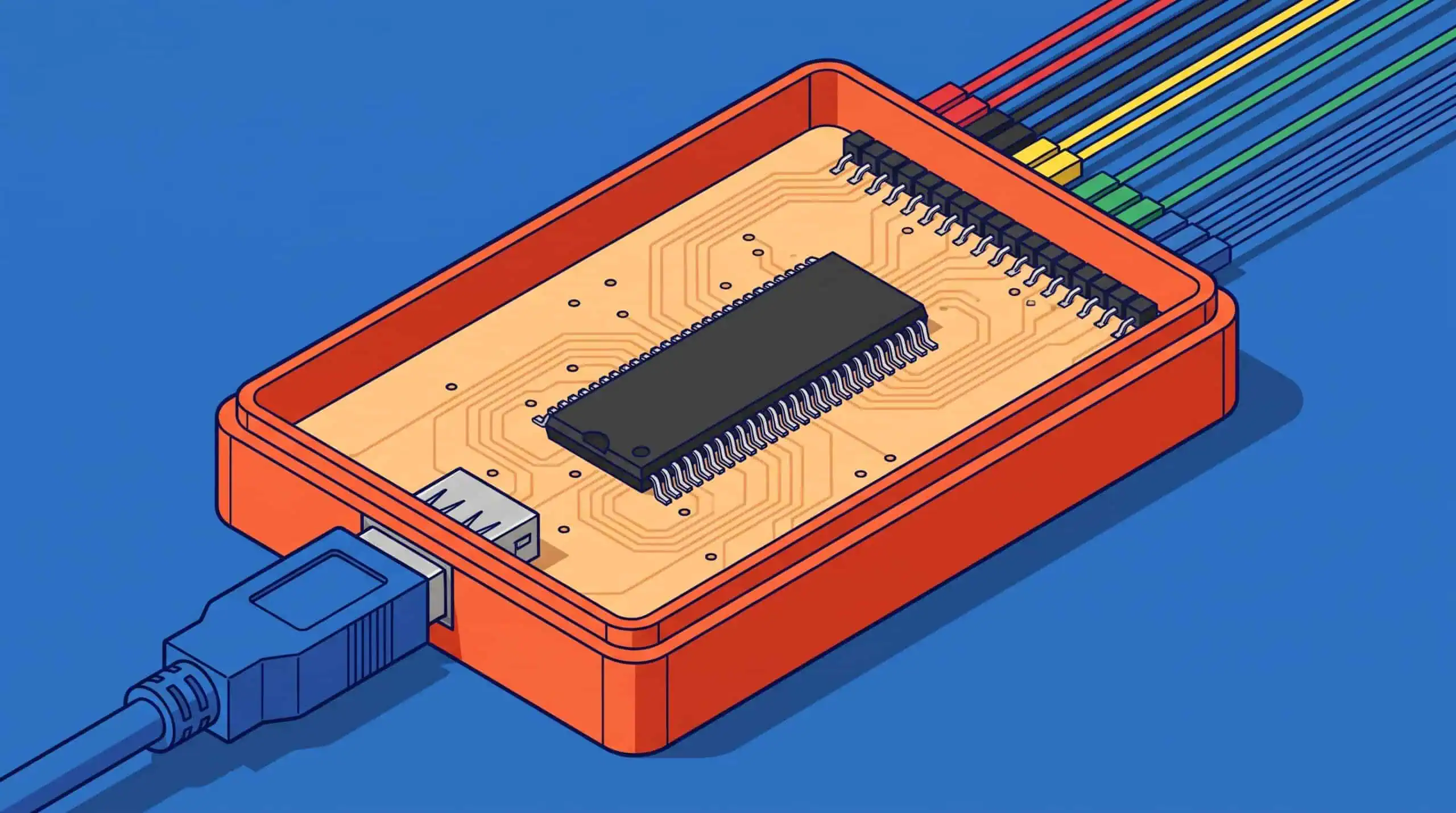
The CY7C68013A-56PVXC is Cypress’s EZ-USB FX2LP, a USB 2.0 peripheral controller with an enhanced 8051 core, in a 56-pin SSOP rated for the commercial temperature range. It is end of life. Infineon, which now sells and supports the Cypress line, has discontinued it. The last delivery date on its discontinuation notice, 2025-09-15, has already passed.
The part still turns up in instrument and evaluation designs that remain in service. Community hardware pages report it in PC-based logic analyzers, and Texas Instruments and Analog Devices evaluation board documents list it as the USB link to the host PC.
CY7C68013A-56PVXC overview and specifications
The FX2LP family (CY7C68013A, CY7C68014A, CY7C68015A and CY7C68016A) shares one Infineon datasheet, document 38-08032. The datasheet cover describes Cypress as an Infineon Technologies company, which is why the end-of-life notice and the replacement both come from Infineon. NetSource lists the part under Cypress in its integrated circuits category.
Each FX2LP device puts a USB 2.0 transceiver, USB-IF Hi-Speed certified, and an enhanced 8051 on one die. The 8051 runs at 48, 24 or 12 MHz with four clocks per instruction cycle. The ordering code breaks down like this, per the datasheet’s ordering code definitions:
- CY: company ID, Cypress
- 7: marketing code, Cypress products
- C: technology, CMOS
- 68: family, USB
- 013A: FX2LP part in the CY7C68013A/14A/15A/16A family
- 56PVX: 56-pin SSOP, Pb-free
- C: commercial thermal rating (I means industrial)
- T suffix, when present: tape and reel
Key specifications from the datasheet and Infineon’s product page:
- USB 2.0 with integrated transceiver, on-chip PLL to 480 MHz from an external 24 MHz (±100 ppm) parallel-resonant fundamental-mode crystal, 12 pF load
- 16 KB on-chip code/data RAM
- Four programmable bulk, interrupt or isochronous endpoints plus one 64-byte bulk/interrupt endpoint, with 8 x 512 bytes of endpoint RAM for EP2, 4, 6 and 8 and four integrated FIFOs
- 8-bit or 16-bit external data interface with GPIF (general programmable interface) and ECC generation
- I2C controller at 100 or 400 kHz, 24 programmable I/Os in this package
- Supply: VCC 3.00 to 3.60 V, 3.3 V typical, with 5 V tolerant inputs
- Operating current: 50 mA typical, 85 mA maximum at USB high speed with the 8051 running
- Suspend current: 300 µA typical
- Ambient temperature: 0 to +70 °C
- Thermal: junction-to-ambient 47.7 °C/W, maximum junction temperature 125 °C
- Package: 56-pin SSOP (300 mil), outline 51-85062, moisture level 3, dry packed, RoHS compliant and halogen-free
There is a single supply rail. One practical limit is easy to miss: the UART isn’t available in the 56-pin package, so serial-port debugging with Keil Monitor isn’t possible on this version.
What FX2LP end of life means for a build plan
Infineon issued product discontinuation notice PD_314_24 on 2024-09-12. It set a last order date of 2025-03-15 and a last delivery date of 2025-09-15. The reason given is that SkyWater, the fab, no longer supports fabrication and there is no alternative way to manufacture the part. Infineon’s product page now shows the part as discontinued.
Franchised distributors list it as obsolete or not orderable. The same notice also discontinues CY7C68014A-56PVXC, the industrial CY7C68013A-56PVXI and the QFN CY7C68015A-56LTXC, so moving to a sibling part doesn’t get around the end of life.
If your product is still in production, the decisions are concrete. Count the builds and field repairs you still need to support. Compare that against what you already hold. Then decide whether to cover the gap with carefully inspected aftermarket parts, start a redesign, or do both on different timelines.
Where the FX2LP shows up in real designs
Vendor design documents
Texas Instruments’ user’s guide for the DDC11xEVM-PDK evaluation kit, which supports the DDC112 and DDC114 current-input ADCs, lists this part as U2 in the bill of materials for the DDCMB motherboard, the kit’s PC interface board. In the same BOM it sits next to a Xilinx Spartan-3E FPGA (XC3S250E-4TQG144C) and a 16 MB asynchronous SRAM. The guide is dated October 2007 and was revised in July 2010.
Analog Devices’ schematic for the AD9528 customer evaluation board (rev C, 2014) shows the part on the sheet titled AD9528 USB SECTION, where it drives the SPI/I2C serial and status lines to the device under test. The sheet notes that the USB section was copied from AD9526EE02A, so it is a reused block. ADI’s schematic for the AD9546 evaluation board (rev B1, 2020) uses the same part in its SERIAL COMM SECTION.
Community teardowns
The sigrok wiki reports the part in several logic analyzers. Its page for the Saleae Logic, an 8-channel USB logic analyzer with sampling up to 24 MHz, names it as the main chip. That is an older product, so it reflects installed base. Sigrok’s Saleae Logic16 page lists it as the USB interface chip next to a Xilinx Spartan-3A XC3S200A FPGA, with port B and D lines and control strobes routed to the FPGA. The same page mentions Logic16 clones, which may not use the same chip.
Sigrok also reports the part as the main chip of the CWAV USBee SX, noting that older units used the original FX2, CY7C68013-56PVC. CWAV closed in 2015 according to that page, and many clones exist. The Lcsoft CY7C68013A Mini Board, which sigrok describes as a Saleae Logic clone, is built around this part, breaks all FX2 pins out to 40 header pins and loads firmware over USB into internal RAM at boot.
At family level only, an Infineon knowledge base article (KBA229176) shows an FX2LP CY7C68013A Mini Board used as a logic analyzer with sigrok PulseView. It names the base CY7C68013A, not this orderable part.
Why it ends up in these designs
The integration does most of the work. One chip gives an instrument or evaluation board its USB 2.0 high-speed link and a controller. The GPIF interface moves data to and from an FPGA, which matches the Logic16 and DDCMB pairings. The 16 KB RAM lets a host load firmware at power-up, which sigrok’s open-source fx2lafw firmware relies on for the Lcsoft board. Pin compatibility with the original FX2 meant products like the USBee SX could move to it without a new layout. The datasheet’s Table 9 maps CY7C68013-56PVC to this part or to CY7C68014A-56PVXC.
Replacement and migration considerations
Infineon names one replacement: CYUSB2315-BF104AXI, from the EZ-USB FX2G3 line. Infineon lists it as active and preferred. It comes in a 104-LGA package (PG-VFLGA-104, 8 x 8 mm), runs from 1.7 to 3.6 V and is rated -40 to +85 °C. Because the package changes from a 56-pin SSOP to an LGA, the move means a new board layout. Infineon’s FX2G3 page makes no statement about compatibility with FX2LP firmware or hardware, so plan to validate both.
The FX2LP relatives in the same datasheet (the 014A, the industrial version, and the QFN, VFBGA and TQFP packages) are family members, not replacements, and several carry the same discontinuation notice. Items to compare against the replacement’s own datasheet:
- Supply range and I/O levels, including whether you rely on 5 V tolerant inputs
- Clock source, against the current 24 MHz crystal and PLL scheme
- Endpoint count, FIFO structure and buffer sizes
- External data interface width and GPIF timing, if an FPGA or ASIC sits on the bus
- Firmware load method and memory size, if a host loads code at power-up
- I2C speed and the number of programmable I/Os
- Operating and suspend current against your power budget
- Temperature range and thermal resistance in the new package
- Host drivers and software, which may need requalification
Sourcing considerations
With Infineon’s last delivery date past, franchised availability is limited and remaining supply sits mostly in the aftermarket. For any obsolete stock, check:
- The full part number, including the C or I temperature suffix and the T tape-and-reel suffix, and 013A against 014A
- Top-side marking against a known-good original. Sigrok’s fx2lafw page warns that some clone boards sold as CY7C68013A boards actually carry the older CY7C68013
- Date codes and a documented traceability chain back to the original source
- Moisture handling: the part is moisture level 3, so confirm dry-pack condition and apply your floor-life and bake rules
- Country of origin on the documentation, matched to your compliance needs
Frequently asked questions
What is CY7C68013A-56PVXC?
It is the EZ-USB FX2LP USB 2.0 peripheral controller from Cypress, now an Infineon company, in a 56-pin Pb-free SSOP for the commercial range of 0 to +70 °C. It combines a Hi-Speed USB transceiver, an enhanced 8051 and 16 KB of code/data RAM.
Is CY7C68013A-56PVXC end of life?
Yes. Infineon’s notice PD_314_24 discontinued it with a last order date of 2025-03-15 and a last delivery date of 2025-09-15, and Infineon’s product page lists the CY7C68013A-56PVXC as discontinued.
What replaces the CY7C68013A-56PVXC?
Infineon names CYUSB2315-BF104AXI (EZ-USB FX2G3) as the replacement for this part. It uses a 104-LGA package, so a board change is required, and Infineon’s FX2G3 product page makes no statement about FX2LP firmware compatibility.
What supply voltage does the FX2LP need?
A single VCC rail of 3.00 to 3.60 V, 3.3 V typical, according to the datasheet. Inputs are 5 V tolerant.
Which products use this FX2LP part?
Texas Instruments’ DDCMB board and Analog Devices’ AD9528 and AD9546 evaluation boards list it in their design documents. Community teardowns on the sigrok wiki report it in the Saleae Logic, Saleae Logic16, CWAV USBee SX and Lcsoft Mini Board.
More integrated circuits and CYPRESS parts at NetSource
Browse the parts we list, with date codes and RoHS status on each part page.

We source it
We source end-of-life and hard-to-find parts too. Send the part number and we'll quote it.
Request a quoteAny part number, in stock or not
More component spotlights
All component spotlights →
MT52L256M32D1PF-107 WT:B: Micron 8Gb LPDDR3 Specs and End-of-Life Guide

MT29GZ6A6BPIET-53IT: Why Industrial SLC NAND Still Matters in Embedded System Design
